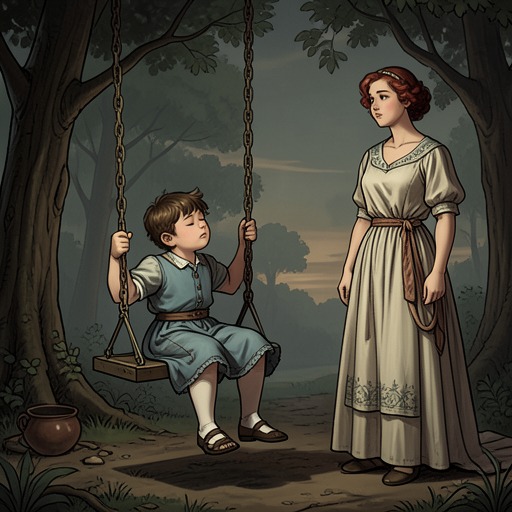
Imagination and Make-Believe
Anne of AvonleaImagination and Make-Believe is more than a habit of inventing stories in Anne of Avonlea: it is a way of perceiving and inhabiting the world, a gift that makes companionship possible and gives ordinary days a private radiance. The novel celebrates its power through Anne Shirley and Paul Irving's shared imaginative outlook, while also showing, through Miss Lavendar Lewis, that fantasy can soften loneliness but cannot always satisfy the desire for real company.
A shared way of seeing
The narrative treats imaginative capacity as something some people possess from childhood, rather than a skill that can be acquired on command. When Anne asks Paul whether she could see his rock people, he explains that his are visible only to him, though she could see rock people of her own. The distinction preserves the privacy of each person's inner world even as Paul recognizes Anne as belonging to the same kind. His friendly squeeze of her hand makes the idea of a shared imaginative nature a moment of personal connection, not merely an abstract claim.
That recognition leads into a lyrical account of imagination as access to a realm of joy and kindred spirits. Its geography is described through the fairy-tale direction east o' the sun, west o' the moon, and its value cannot be purchased or worn away by the passage of years. The contrast is deliberately material: possessing this inward country in a garret is better than living in a palace without it. Imagination's worth therefore lies not in wealth or outward circumstance but in the capacity to experience delight and fellowship within them.
Paul's imaginative language
Paul's imagination is most fully expressed in the explanations he invents for the natural world. He tells Anne that he once imagined the evening star as a lighthouse in the land of the Fairies, and an angel as a tall, white figure who walks after sunset, singing flowers and birds to sleep. These images are not presented as claims he literally believes. Paul carefully distinguishes thinking from believing: the possibility of imagining something is enough to make it meaningful to him.
His thoughts extend this imaginative remaking of the world into a small tragedy. A birch tree in the garden has died; although his grandmother attributes its death to salt spray, Paul imagines that its Dryad wandered off and became lost, leaving the tree lonely enough to die of a broken heart. The fanciful explanation gives the tree an emotional life and turns a physical event into a story of separation. Paul's solemn insistence that foolish Dryads must face consequences also gives his invented world a moral logic of its own.
He imagines the new moon as a golden boat carrying dreams, some of which spill into people's sleep when it tips on a cloud. Violets become fragments of sky left when angels cut holes for the stars; buttercups are made from old sunshine; sweet peas are butterflies that will become so in heaven. The images are varied, but each connects a familiar object to a larger, imaginative order. Anne does not dismiss them as childish oddities. She calls them strange and beautiful, recognizes why people unable to think in this way might find them queer, and predicts that Paul may become a poet. Her response makes receptive attention part of the scene: imagination flourishes when another person listens without requiring it to prove itself as fact.
Wonder in ordinary days
The book sets such vivid inventions beside the quieter pleasures of everyday life. Anne tells Marilla Cuthbert that the sweetest days are often not the ones marked by a splendid or exciting event, but those in which small pleasures follow softly, like pearls slipping off a string. Life at Green Gables offers many such days, with work, dreams, laughter, and lessons between the scattered adventures and misadventures. This view connects imagination not only with extraordinary visions but also with the ability to notice and value modest happiness.
On one late-August day, Anne and Diana Barry row the twins down the pond to the sandshore to gather sweet grass and paddle in the surf. Later Anne visits Paul, whom she finds reading fairy tales beside the fir grove. The day's simple sequence of shared outdoor pleasures and a visit with an imaginative child helps place wonder within ordinary companionship. Imagination need not require a dramatic adventure: it can be part of how a day is remembered and enjoyed.
Make-believe, solitude, and company
Miss Lavendar's tea party reveals a more vulnerable use of make-believe. When Anne and Diana visit, Miss Lavendar admits that she had pretended to expect guests because she was lonely and loved the right kind of company. She had cooked for the imaginary party, decorated the table, set out her mother's wedding china, and dressed for the occasion. Charlotta the Fourth, she says, was lonely too. Diana finds the performance peculiar for a woman of forty-five, but Anne's delighted question about whether Miss Lavendar also imagines things changes the encounter: the admission becomes a point of recognition between kindred spirits.
Miss Lavendar calls herself foolish when discovered, yet defends the freedom to be silly when it harms no one. Her invented gathering is a private compensation for the few people who make the journey to her distant home. Once Anne and Diana are actually there, the prepared tea can become a real welcome. The scene holds both sides of make-believe together: it responds to an absence, but can also create a setting in which genuine company becomes possible.
Later, Anne walks alone through the beech woods as December turns dull and the first snow begins. She is not lonely, because her imagination peoples the path with merry companions and sustains a pretend conversation. The narrator observes that these imagined companions always say the thing she wants to hear, allowing her to answer as she wishes. The freedom of that exchange is contrasted with the failures of conversation in real life, without suggesting that imagined company is identical to human presence.
At Echo Lodge, the contrast becomes explicit. On a dark, stormy evening, Miss Lavendar says that dreams and make-believes can be enough in daylight, but fail to satisfy when darkness and storms come; then a person wants real things. She recalls that at seventeen she expected realities to await her in the future and had not imagined herself at forty-five, white-haired and filling her life with dreams. Anne's presence matters precisely because it is not only imagined: she brings youth and companionship into Miss Lavendar's secluded life. The novel thus treats make-believe as a cherished and enduring resource, while recognizing the moments when a dreamer's deepest need is for another person to be there.